
What Is Amazon S3 Storage?
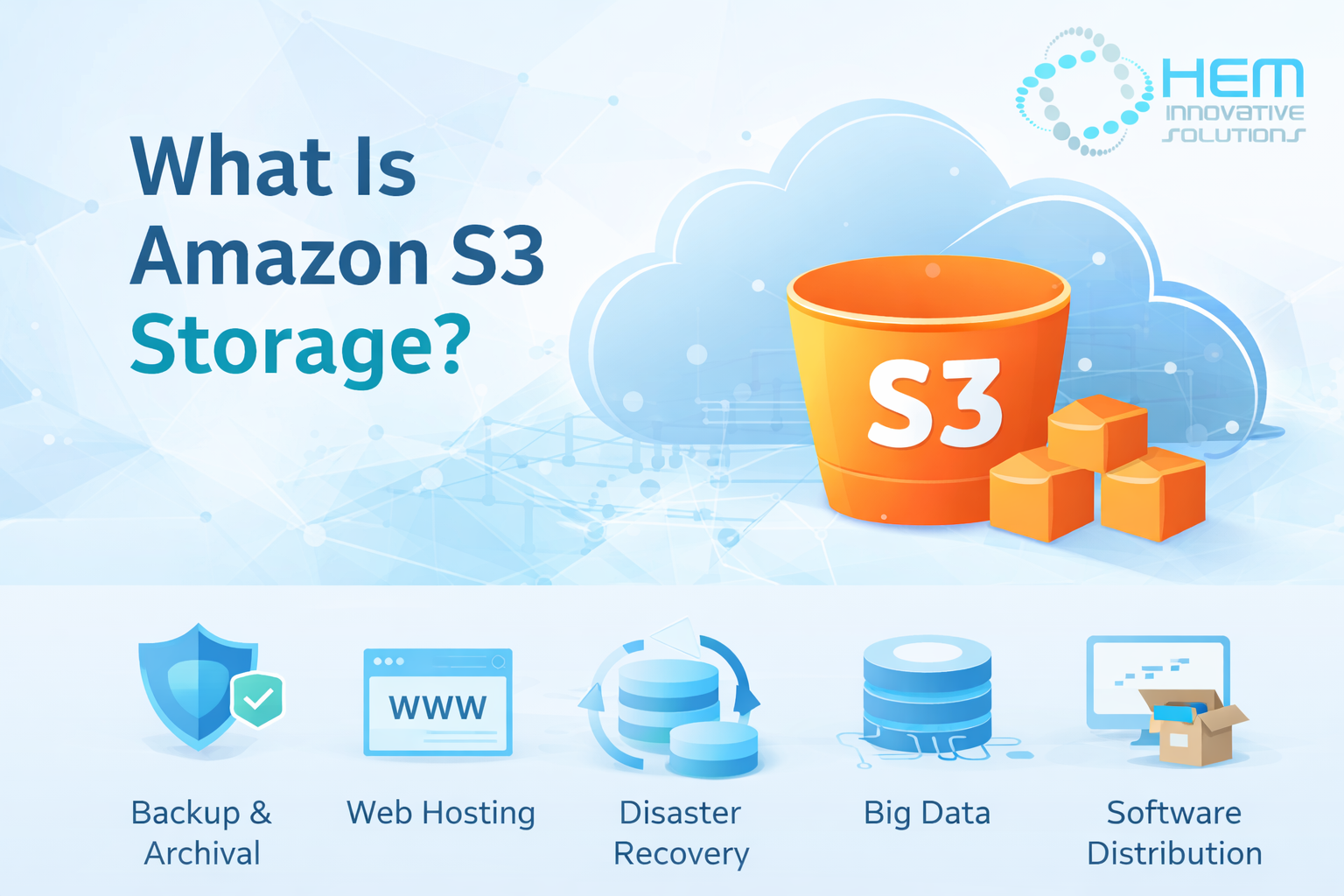
Amazon Simple Storage Service (Amazon S3) is a highly scalable cloud storage service built on object storage technology. It is designed to deliver exceptional durability, availability, and performance for storing and retrieving data from anywhere on the internet. With Amazon S3, users can store unlimited amounts of data and access it through the AWS Management Console, SDKs, or the powerful S3 API. Key Features of Amazon S3 1. Buckets Data in S3 is stored in containers called buckets. Each bucket can hold an unlimited amount of unstructured data such as images, videos, backups, logs, and application files. 2. Elastic Scalability There is virtually no storage limit in S3. Individual objects can be up to 5 TB in size, making it suitable for large-scale storage needs. 3. Flexible Data Organization Each object stored in S3 is identified by a unique key. Metadata can be attached to objects, allowing flexible and customizable data organization. 4. Easy Data Sharing S3 makes it simple to securely share data with users inside or outside your organization via direct download links. 5. Granular Permissions Access control policies can be applied at both bucket and object levels, ensuring only authorized users can access specific data. 6. Powerful APIs Amazon S3 offers REST and SOAP APIs that integrate seamlessly with third-party tools and enterprise systems. 5 Major Use Cases of Amazon S3 1. Backup and Archival S3 is widely used for secure backup and long-term data archiving. Its redundant architecture ensures high durability, protecting critical business data. Versioning allows organizations to retain multiple file versions and restore previous copies when needed. 2. Content Distribution and Web Hosting S3 integrates with Content Delivery Networks (CDNs) to distribute content globally with low latency. It is ideal for: Hosting static websites Delivering media files Managing high-traffic workloads Custom domains and SSL certificates can be configured for secure web hosting. 3. Disaster Recovery With cross-region replication, S3 automatically copies data across multiple AWS regions. In case of system failure or disaster: Data can be restored quickly Downtime is minimized Business continuity is maintained 4. Big Data and Analytics S3 serves as a data lake for structured and unstructured data such as: Log files Sensor data Social media feeds It integrates with tools like: Apache Hadoop Apache Spark Amazon Athena Amazon Redshift This makes large-scale data analysis efficient and cost-effective. 5. Software and Digital Asset Distribution Organizations use S3 to distribute: Software packages Firmware updates Digital media Access control policies and signed URLs ensure secure distribution. How Amazon S3 Works Amazon S3 stores data as objects instead of files or blocks. Each object includes: Data Metadata A unique key Objects are distributed across multiple disks and Availability Zones to ensure high durability. Data Protection Data is automatically replicated Integrity is verified through hash checks Corrupted data is restored using redundant copies Core Components of S3 Buckets Buckets are logical containers for storing objects. Important facts: No official storage limit Maximum object size: 5 TB Bucket names must be globally unique Keys Each object has a unique key that acts like a file path. The combination of: Bucket name Object key Version ID Uniquely identifies an object in S3. AWS Regions and Availability Zones Amazon operates data centers in multiple geographic regions worldwide. Best practice: Store data in the region closest to users to reduce latency and cost. Each region contains at least three Availability Zones, which provide fault tolerance by replicating data across independent data centers. Amazon S3 Storage Classes S3 offers multiple storage classes (tiers) based on access frequency and cost optimization. 1. S3 Standard Best for frequently accessed data. 99.999999999% durability 99.99% availability Data replicated across multiple Availability Zones 2. S3 Standard-Infrequent Access (Standard-IA) Ideal for data accessed less frequently but requiring fast retrieval. Lower storage cost Retrieval fee applies 99.9% availability 3. S3 One Zone-IA Lower-cost option storing data in a single Availability Zone. Best for: Secondary backups Re-creatable data 4. S3 Intelligent-Tiering Automatically moves data between tiers based on usage patterns, optimizing costs without performance impact. 5. S3 Glacier Designed for long-term archival. Minimum storage duration: 90 days Retrieval time: 1–5 minutes (expedited) 6. S3 Glacier Deep Archive Lowest-cost storage for rarely accessed data. Minimum storage duration: 180 days Retrieval time: 12–48 hours Final Thoughts Amazon S3 is one of the most powerful and flexible cloud storage solutions available today. Whether you need backup, disaster recovery, content hosting, analytics storage, or archival solutions, S3 provides unmatched scalability, durability, and security. Its multiple storage tiers allow organizations to optimize costs while maintaining performance and reliability. Also Read: The Advantages Of Using Managed Services For Microsoft Azure